Showing posts with label World War II Escape Routes. Show all posts

Thursday, November 7, 2013

Chemin de la Liberté/Freedom Trail -Top 10 Magic Mountain Moments (Summer 2013)

Yesterday it was grey and overcast and the rain did not stop. I found myself thinking back to the Pyrenees Mountain Adventure treks this summer along the Chemin de la Liberté/Freedom Trail. Four groups attempted to cross the Pyrenees mountains and everyone who started made it into Spain.

Here are my top 10 favourite magic mountain moments from the four treks. They are in no particular order:

1. The Border Crossing. Starting from St Girons, the border is crossed on day 4. After much effort, hardship and determination we are at the border and can pass from France into Spain. A great moment for everyone who made the crossing.

The Dos group from Holland celebrate reaching the French/Spanish border. Freedom is very close...


2. Polly Bagging. Sliding down a safe snow slope using a large plastic bag as a tobogan. This was great fun and an ideal way to release the tension that had built up descending the steep snow slope directly below the border.


3. Louis Barrau Memorial. Killed by the Nazis aged 18, a memorial has been erected by the barn where he was shot. Someone picked wild flowers from the meadow next to the barn and placed them on the memorial. They had a son of similar age. A beautiful gesture in a beautiful setting.

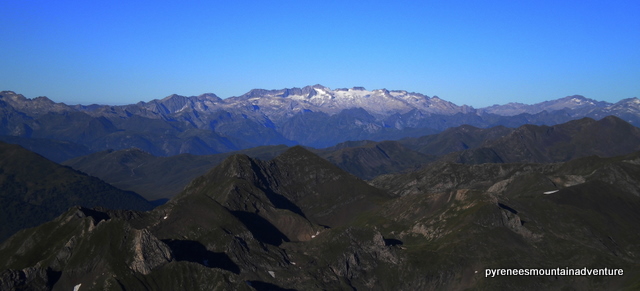
Great view across to the high Pyrenees from near where Louis Barreu was killed.


4. The Scenery. It is not just the spectacular scenery of which there is plenty.......

Mont Valier dominates the high mountain stages of the Chemin de la LIberté (Freedom Trail)


.........it is the group finding the time to stop, look up and enjoy the views. To soak up the scenery they were immersed in.


Soaking up the scenery towards the end of the Freedom Trail (Chemin de la Liberté)


5. The Silence. Ten minutes silence at the border. No wind, no words. Time too reflect. 'Find beauty; be still.' We had. We were.


The view back into France showing the route of the Freedom trail (Chemin de la Liberté) as it climbs up to the border


6. The Shadows. Griffon vultures flying above us, close enough to cast shadows that raced across the ground where we were.


7. The Summit. Only one group chose the optional extra day at Refuge Estagnous to ascend Mont Valier which dominates day 3 and 4 of the trek. The weather was grey and overcast. Visibility was poor and it was cold. Having reached the summit, the clouds parted and for a short time we were rewarded with tremendous views.

Summit view from Mont Valier the mountain that towers above the Estagnous Refuge and the route of the Freedom Trail (Chemin de la Liberté)


A Pyrenees Mountain Adventure group on the summit of Mont Valier


A similar thing happened with the same group the day before. Starting out in poor weather, we eventually find ourselves above the cloud and out of trouble.

8. The Support. The Chemin de la Liberté/Freedom Trail  is tough. It was great to see the shared hardship brings people together. I saw new friendships form and old friendships strengthened. I saw kindness and care. People helping each other through difficult times - whether a difficult section of path, a drop in morale or fatigue.

9. The Storm. At Refruge Estagnous, which is spectacularly located in the high mountains, the sunsets can be unforgettable. What was more memorable for me happened after most people had returned inside after the sun had set. In the fading light, far in the distance, dark storm clouds were being illuminated from inside by lightning but because of the distance the thunder could not be heard.

10. The Omelette. At the Gite de Rouze I had an omelette with wild, girolle mushrooms picked from the local forest. I know that at the end of a hard days walking any food tastes good but the best omelette ever!

Thanks to everyone who trekked with Pyrenees Mountain Adventure along the Chemin de la Liberté/Freedom Trail in 2013. It was a pleasure to share the journey with you.

Friday, September 27, 2013

This Is A (Real) Rebel Song

2013 is the 70th anniversary of the writing of the 'Chant des Partisans' which became one of the most important protest anthems ever written.

'Friend, if you fall, another will emerge from the shadows to fill your place. Tomorrow, black blood will dry in the sun on the roads'

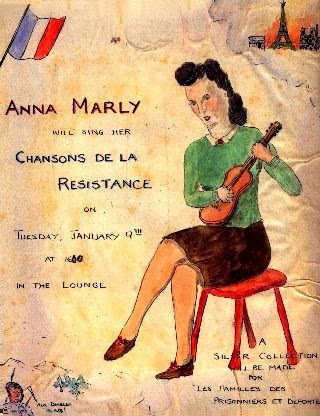
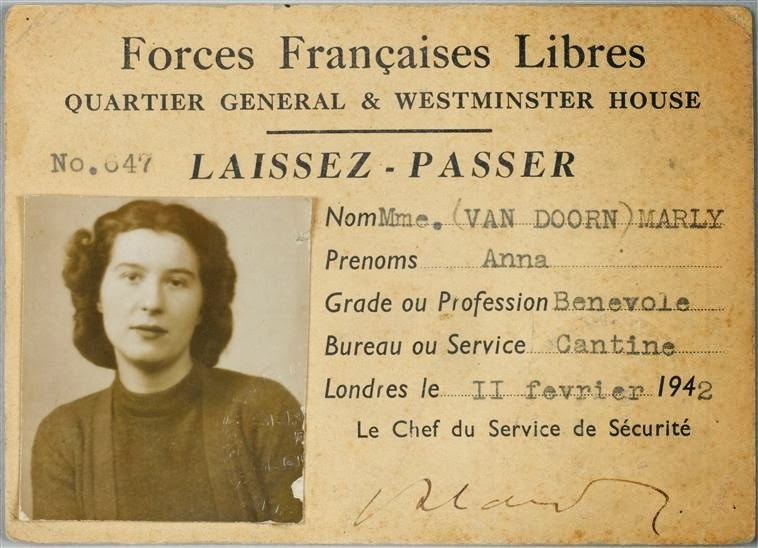
7O yeras ago in 1943, World War II is raging and France is occupied by Nazi forces. Many French have escaped to join the Free French Forces based in London. One such person is Anna Marly.

Anna was born Anna Yurievna Betulinskaya in Russia in 1917 into an aristocratic family. She fled the country after the death of her father at the hands of the Bolsheviks. She eventually settled in France and by the age of 17 was performing her own songs in the caberet clubs of Paris. She changed her name to Marly (apparently chosen from the phone book) because she found her family name was too difficult for the French to pronounce.

At the end of 1940 after the invasion and capitulation of  France, Marly escapes to London and makes contact with the Free French Forces.


She is still singing in clubs and is heard performing by Joseph Kessel and Maurice Druon who use one of her songs as the basis of the 'Chant des Partisans/Song of the Resistance'.


The French lyrics are written based on the original Russian lyrics and set to Anna's music. The song is played on BBC Radio, which is broadcast to occupied France, and becomes the unofficial French national anthem after the Nazi forces ban 'La Marseillaise'.


Ami, entends-tu le vol noir des corbeaux sur nos plaines ?
Ami, entends-tu les cris sourds du pays qu'on enchaîne ?
Ohé, partisans, ouvriers et paysans, c'est l'alarme.
Ce soir l'ennemi connaîtra le prix du sang et les larmes.

Montez de la mine, descendez des collines, camarades !
Sortez de la paille les fusils, la mitraille, les grenades.
Ohé, les tueurs à la balle et au couteau, tuez vite !es grenades.
Ohé, les tueurs à la balle et au couteau, tuez vite !
Ohé, saboteur, attention à ton fardeau : dynamite...

C'est nous qui brisons les barreaux des prisons pour nos frères.
La haine à nos trousses et la faim qui nous pousse, la misère.
Il y a des pays où les gens au creux des lits font des rèves.
Ici, nous, vois-tu, nous on marche et nous on tue, nous on crève...

Ici chacun sait ce qu'il veut, ce qu'il fait quand il passe.
Ami, si tu tombes un ami sort de l'ombre à ta place.
Demain du sang noir sèchera au grand soleil sur les routes.
Chantez, compagnons, dans la nuit la Liberté nous écoute...

Ami, entends-tu ces cris sourds du pays qu'on enchaîne ?
Ami, entends-tu le vol noir des corbeaux sur nos plaines ?

Friend, do you hear the crows' dark flight over our plains?
Friend, do you hear the muffled cries of the country being shackled?
Ahoy! Resistants, workers and farmers, the alarm has sounded!
Tonight the enemy shall know the price of blood and tears.
Climb out of the mine, come down from the hills, comrades,
Take the guns, the machine guns and the grenades from under the straw;
Ahoy killers, with bullets and knives kill swiftly!
Ahoy "saboteur", be careful with your burden of dynamite!
We're the ones who break the bars of jails, for our brothers,
Hate pursuing us, it's hunger that drives us, dire poverty.
There are countries where people sleep in their beds and dream.
Here, you see, we walk and we kill and we die
Here, each one of us knows what he wants, what he does when he passes by;
Friend, if you fall, a friend comes from the shadows in your place.
Tomorrow, black blood will dry in the sun on the roads
Sing, companions, in the night, freedom listens to us.
After the war General de Gaulle said that Marly 'made her talent into a weapon for France' and it is suggested that her song should become the new French national anthem. In 1985 she is awarded the Légion d'Honneur/ Knight of the Legion of Honour in recognition of the part she played during WWII.

Friday, August 16, 2013

Smugglers in the Night

In World War II the 'passeurs' - the men and women that helped Jews, downed allied aircrew and young French men who did not want to do forced labour, escape to Spain along ascape lines like the Freedom Trail, were often smugglers. Smugglers were ideal because they knew the mountains well and were skilled in staying one step ahead of the security forces.

Smugglers still exist and smuggling goods across the Pyrenees is still going on today. Differing tax levels lead to price differentials in different countries. When the countries are seperated by a common border 'leakage' of goods across the border from the low price to the high price country is possible and a strong financial incentive exists to smuggle.

Cigarettes in Spain are half the price of cigarettes in France. A 20kg sack of cigarettes smuggled into France from Spain can make you 1500 euros on the black market. Customs teams have people on the gound in the mountains attempting to stop the trafficking.


Freedom Trail In The Press


Tuesday, January 22, 2013

Cruel Crossing

In November 2011 BBC Radio 4 broadcast a programme (in 2 parts) called The Freedom Trail. In it we follow Edward Stourton as he makes the crossing from France into Spain following the route of an old WW II escape route called Le Chemin de la Liberté or Freedom Trail.

The programme, narrated by Edward Stourton, is an account of his 4 day journey as he walks the most dangerous WWII escape route over the Pyrenees. As well as a travelogue of his own crossing, Stourton uses this a jumping off point and broadens the picture to include escape routes over the whole of the Pyrenees. There are the remarkable stories of those who escaped to freedom but also of those who risked their lives to help those attempting to escape Nazi occupied France.

Edward Stourton has now turned the radio programme into a book which will appear in April 2013. It is called Cruel Crossing: Escaping Hitler Across the Pyrenees.


The book is based on his own experiences of crossing the Pyrenees and first hand accounts from those who made the journey during  WW II. As well as interviews with survivors from the time, Stourton also had access to diaries and journals. Relatives were also a precious source of information.

It is obvious from the book that tremendous courage and determination was shown by those attempting to escape and all those in the support network that helped so many to succeed. Exhaustion, malnutrition and sickness had to be contended with and there was the constant fear of capture, torture and death. Many of those in the Allied forces who successfully crossed into Spain, later returned to fight or to gather intelligence and work with the French. 

We also learn that  it was not only forces personel who wanted to escape. A large number of Jews and communists made the crossing to escape persecution and the Death Camps. Young French also crossed to escape the STO (Service du travail obligatoire) or Compulsory Work Service/Forced Labour.

Wednesday, July 18, 2012

Freedom Trail 2012

Early July 2012 found myself completing the Freedom Trail for the 3rd time. The Freedom Trail is a four day walk that retraces a WWII escape route, used by those escaping Nazi oppression, from France into Spain across the Pyrenees mountains.


On the French Spanish border looking into Spain and 'freedom'.


In 2010 I was solo and the following year I helped a group complete the Trail as their D of E Gold expedition. This year I helped  with the walk that is organised every July to commemorate the escapers, evaders and helpers or 'passeurs' who made the journey during the dark days of the Nazi occupation of France. At various points along the route, including the site of a crashed RAF Halifax bomber,  there are memorials where wreaths are laid and speeches made . There were over 100 participants this year - more than in previous years in part boosted by the publicity from a BBC Radio 4 programme in 2011. Those taking part included a group raising money for the Royal British Legion and a group of soldiers representing NATO. By chance there was also the father of an ex pupil of mine from my days as a teacher in Kent!

The group I  looked after included walkers from Britain, Ireland, Belgium and the Netherlands. One of the only groups to finish the walk as a single unit and singing! A great bunch!

The Four Nations Team

The route between St Girons in France and Esterri in Spain is a test of strength, stamina and character.  Several cols have to be crossed above 2400m with snow still remaining from the winter. In all  50 miles are covered over the four days in awe inspiring scenery.


Looking down on the Refuge des Estagnous


Not all the walkers made it to Spain this year with several dropping out with injuries. There is always next year!


An injured knee for this walker made it too painful to continue


 During WWII the route was taken by Jews fleeing from their German oppressors, by many R.A.F. and American airmen who had either crash-landed or parachuted to safety after being shot down over Nazi-occupied Europe but also by hundreds of Frenchman escaping forced labour in Germany the dreaded STO - Servive du Travail Obligatoire.


Nazi propaganda about the STO. 'The bad days are over. Dad earns money in Germany.'

The helpers or 'passeurs' were local men who knew the mountain paths and tracks by heart and were crucial to helping people escape. Many paid with their lives - caught and shot immediatley. This was sometimes due to betrayal by fellow countrymen who passed on information to La Milice - the feared and hated Vichy-run paramilitary force. More than 100 helpers or 'passeurs', like 19 year old Paul Barreu, were arrested and shot.

The memorial to Paul Barreu

The Freedom Trail escape route remained operational for the duration of the war in part due to it running through such difficult terrain - it was very difficult to police.

I thoroughly enjoyed helping out with the Commemorative Freedom Trail in 2012 which was well organised by Scott Goodall and Paul Debons. Thanks to them, all the helpers and of course all the walkers.

Have you been inspired by what you have read and seen? Are you ready for the challenge? Pyrenees Mountain Adventures can help you organise your Freedom Trail Escape. See the website for more information www.pyreneesmountainadventure.com

Thursday, September 9, 2010

I Want My Freedom


Part of my work involves helping several schools deliver their Duke of Edinburgh programme. There is a group at one of the schools, who want to walk an old WWII escape route, from France into Spain, as their gold qualifying expedition in 2011.

This route is called 'The Freedom Trail' or 'Le Chemin de la Liberté'. I have recently walked a 4 day segment of the trail to be able to tell the group more about it. Just like Duke of Edinburgh gold qualifiers, I was self sufficient - carrying all I needed for the trek (tent, sleeping bag, food, stove etc)

Day 1. Seix (500m), Col de la Core (1395m), Cabane de la Subra (1499m).
Distance 19km. Ascent 1079m


In the distance, Col de la Core

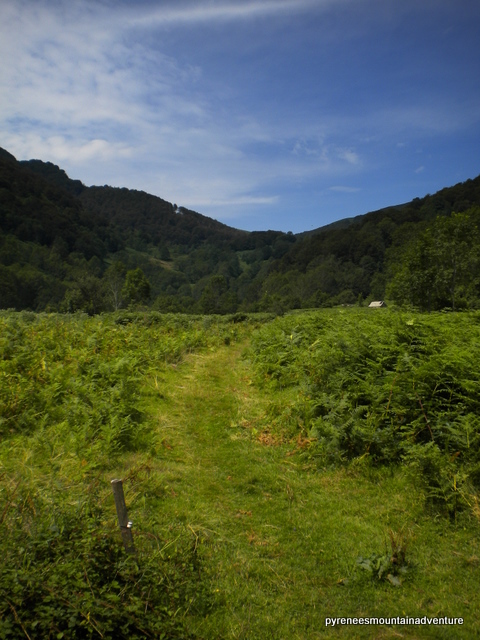
Gentle introduction with some road walking. So lush and green. Friendly shepherd and his partner at the cabane looking after the cattle for the summer.

Day 2. Cabane de la Subra (1499m), Col de Craberous (2382m), Cabane des Espugues (2110m), Col de Pécouch (2462m), Refuge des Estagnous (2245m)   
Distance 10km. Ascent 1386m
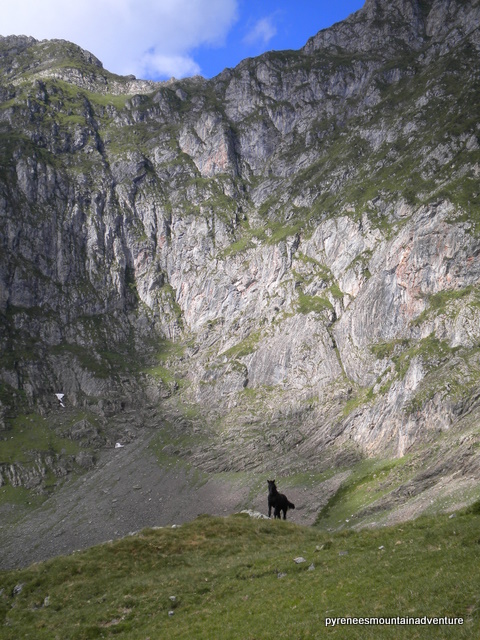
Merens horse


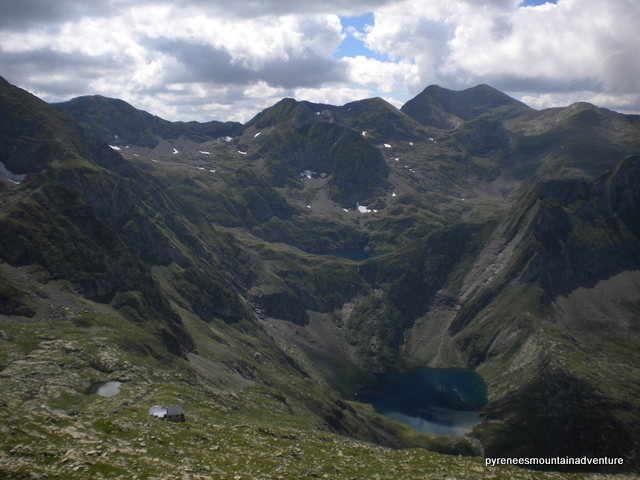
 Col de Pécouch, looking towards Refuge Estagnous and Lac Rond.


Great day. Marmot watching a highlight! Merens horses as well. Awesome views.

Day 3. Cabane Estagnous (2245m), Mont Valier (2838m), Cabane Estagnous (2245m), Etang Long (2125m), Col de la Clauere (2382m), Cases de Bonabe (1400m), Port/Col de Salau (2087m)
Distance 18km. Ascent 1562m
Early morning view from the col before the Mont Valier summit
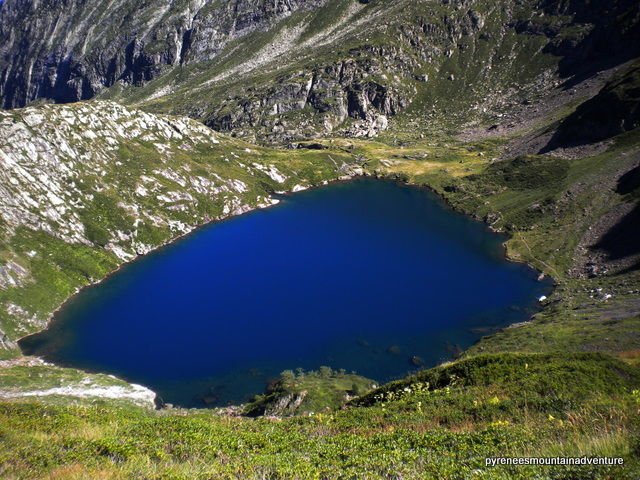
Lac Rond
Ascent of Mont Valier without full pack. Great views. The blue of Lac Rond is unreal. Some snow on approach to Spanish border. See herd of isards from col, a golden eagle and many vultures. Route markings less clear in Spain.
N.B. A long day. An alternative would have been to cut out the ascent of Mont Valier. Another alternative would be to keep the ascent of Mont Valier and camp just over the Spanish border. This would shorten day 3 and day 4 could be cut as well (see below). There is the option to stay at the refuge.

Day 4. Port/Col de Salau (2087m), Salau (850m), Seix (500m)
Distance 21km. Ascent 0m
Early morning light looking into Spain from Col de Salau
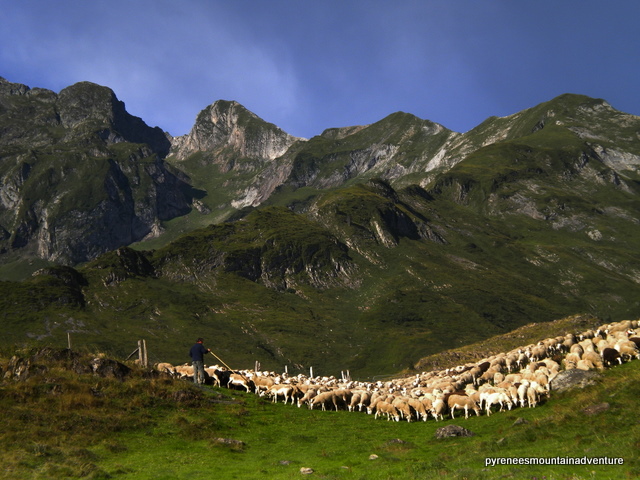
Shepherd herding his sheep
Great light this morning. Passed shepherds herding sheep.
N.B. Route includes 14km of road walking between Salau to Seix beside River Salat. Pleasant enough, but it might have been better to finish at Salau, where there was a nice café, and arrange transport to Seix.


Interested in summer treks like this? Take a look at what Pyrenees Mountain Adventure has to offer here.

There is more information about the Duke of Edinburgh award here.

"Thousands of tired, nerve-shaken, over-civilized people are beginning to find out that going to the mountains is going home; that wildness is a necessity..."  John Muir, 1898