Showing posts with label Bears. Show all posts

Tuesday, January 7, 2014

Bears - Myths and Realities

The exhibition at the Natural History Museum in Toulouse 'Bears - Myths and Realities' was interesting, enjoyable and at the same time thought provoking.


The 8 species of bear around the world were introduced using stuffed bears and then the exhibition went on to concentrate on the brown bear in the Pyrenees and the relation between bears and humankind from the stone age to the present. At one time revered and 'king' of the animals, the brown bear was demonised from the middle ages and hunted to near extinction. The population of brown bears in the Pyrenees was thought to be unsustainable so bears were introduced from Slovenia. Bear cubs are being born but the bear population remains too small at around 25.

Skeleton of  the Pyrenean brown bear Papillon.
I was surprised by the size of the brown bear skeletons.The skeleton of Papillon who lived to the age of 28, which is very old for a bear in the wild, was smaller than I had expected although the claws were enormous.


Scan of a young, healthy brown bear
Scan of brown bear Papillon's skull  who died aged 28.
The scan of a healthy brown bear skull was contrasted with the skull of the old male brown bear (Papillon). The difference in the state of the teeth was very clear.


This quote suggesting that how we have treated the brown bear, and continue to treat it is, reflects badly on ourselves summed up the pro bear bias. The anti bear arguments from hill farmers with animals to rear, one side of a continuing heated debate, were not touched on .

The exhibition Bears - Myths and Realities is at the Natural History Museum in Toulouse until 30th June 2014.

Thursday, November 7, 2013

Film of Brown Bear

Latest brown bear images from the Pyrenees captured by an automatic camera. Unusually it is daytime. The female bear is Hvala, one of the bears successfully reintroduced from Slovenia. The name means Thankyou in English. The 2 bear cubs were born this year.


Thursday, October 10, 2013

Bears: Myths and Realities

Bears, Myths and Realities is the new exhibition event at the Natural History Museum in Toulouse which runs from 13th October ton the 30th June 2014. 


The bear is a  mythical animal and until the Middle Ages in France was regarded as the king of the animals with bear worship popular in some parts of the Pyrenees . It was the Catholic church at this time which began to demonise the bear and the cult of the bear. The lion was promoted as the real king of the animals and bears were persecuted and hunted to near extinction.

The exhibition looks at how, whether revered or feared, the bear is the object of many fantasies and desires, between attraction and aversion.

Perhaps the fascination about bears starts with the fact that they resemble ourselves in many ways. They can walk upright, have closely human-like ears, have a similar diet, and leave tracks with the whole of their back foot (heel, arch and toes). In France the bear is given human names like Martin or  lou pedescaous (le va-nu-pieds, or ‘the barefooted one’),  loucourailhat (‘the vagabond’) and Mousu (‘le monsieur’).

There are examples of the 8 different bear species from around the world. The brown bear from the Pyrenees is represented by the Canelle the last 'authentic' female bear in the Pyrenees, shot by a hunter in 2004. Her pelt has been mounted and on display.


The exhibition comes at a time when the tension between the pro and anti brown bear reintroduction factions has heightened. Those previously against the reintroduction of Slovenian bears to boost the population of bears in the Pyrenees (largely farmers and shepherds in the mountains) are now not only calling for no further reintroductions, but that the existing brown bears should be removed. They have threatened to take measures into their own hands although brown bears remain a protected species and killing them remains illegal.

Website: Natural History Museum of Toulouse

Thursday, January 17, 2013

Bear Naming


The 3 bear cubs born in the Pyrenees in 2011 have just been named. Over 20 000 suggestions were made to the organisers of the naming operation Pay de l'Ours - Adet. Pay de l'Ours - Adet is an orgaisation campaigning for a viable brown bear population in the Pyrenees.

The names chosen were Callisto et Soulane for the 2 females and Pépite for the 3rd bear cub whose sex is not yet known.

Callisto :
A Nymphe in Greek mythology, Callisto on h
er death was transformed into the constellation The Big Bear by Zeus.

Soulane :
The name in the Pyrenees given to the sunny side of a valley

Pépite :
Nugget as in nugget of gold.
Pyrénées : Les oursons de 2011 ont un nom et un parrain


Sunday, September 2, 2012

New Cubs for Pyrenees Bears


The brown  bear population in the Pyrenees has grown by three or four cubs this year. The Pyrenees remains  the last  habitat of brown bears in France.

This is good news for those who are encouraging efforts to maintain a viable bear population in this mountainous region.  Experts on the Spanish side of the Pyrenees told French counterparts they had observed bear cub prints – and then taken a photo of a female bear, “Caramelles”, with two young.
 
Alain Reynes of Pays de l’Ours-Adet, an organisation which campaigns for  the reintroduction of bears said: “Caramelles was born in 1997 and it’s not the first time she’s had a litter. Prints were also found of a little cub alongside those of another but we lack precise data, we don’t know if there were one or two cubs.”

At the end of 2011 best estimates put the number of brown bears in the Pyrenees at about 21 so the latest births put the number at around 24 or 25. However precise facts about numbers will have to wait.

Supporters of an increase in the number of bears and the return to a viable bear population, are hoping that a different male bear is the father this time. The father of all the young in recent years has been an ageing male called Pyros. This is not good news for the genetic diversity of the bears. To have another male bear fathering cubs would be healthy for the long term health of the population.

“Even with these births the bears remain a species in critical danger of extinction,” Mr Reynes said,  “We have high hopes for the government biodiversity conference next month to find out what the government is planning to do for the bears.”

Supporters say the government has a duty to help the bear population under a European “habitats” directive, and that the conference will be the ideal moment to address the problem. A previous official plan to help the bears expired 3 years ago.

The last government broke promises to introduce a new bear lin 2011 following protests from farmers who say they are dangerous to their livestock and reduce their income.

There have been several succesful reintroductions of bears from Slovenia in the past. Three were introduced in 1996-7 and five in 2006 to boost the native population. The last bear of original Pyrenees stock was shot by a hunter in 2004.

Monday, April 16, 2012

From the Ariege to the Big Apple

With the arrival of Spring and the rise in temperature, the brown bear population in the Pyrenees mountains is waking up after the winter hibernation.


The film shows the male adult brown bear Balou soon after leaving his hibernation site (16 March) The bear is attracted to this tree because a mixture of cows blood and mashed up sardines has been spread on it.  It is important to attract the bear to this point because nearby is an automatic camera. The captured image is one way to keep a track of the bear population. Another is by using radio collars like the one Balou can be seen wearing. The signal emitted by the collar helps to locate the bear and track its movements.

About 20 live in the Pyrenees at present. This number is growing due in part to the programme of introducing bears from Slovenia to boost the Pyrenean population and add new stock but the growth in numbers is slow and 20 is still not  a viable population.

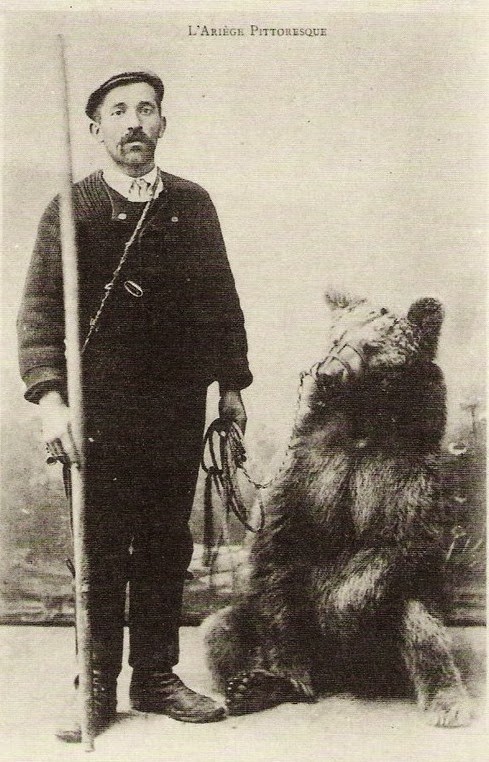
At the end of the XIX century bear numbers were much larger particularly in the Couserans region of the Eastern Pyrenees. Life was very hard for the inhabitants and some had the idea to earn their living by becoming bear tamers.


Bear cubs, often left after the mother had been shot, would be trained to do tricks and would be displayed from town to town. The public would pay to see the bear perform. The men were called "montreur d'ours" — literally, "displayer of bears".


In villages like Ercé, Ustou, Aulus in the Couseran area of the Ariege, bear taming became something of an industry. Ercé even had a 'bear training school'

Some Ariege bear tamers travelled far from France including to America realising a better living could be made in the U.S. Some made money travelling with their bears dispalying them from town to town while others became animal trainers in the circus. Others changed their occupations completely and went to work in the mines or in hotels and restaurants, notably in New York.

In New York, it is in Central Park that the immigrants from the Couseran often meet near a rock formation called Ercé Rock, to exchange news from the Pyrenees or prepare for a new arrival from the the 'old' country.


Wednesday, November 16, 2011

Bear Cubs Are Named


The 4 bear cubs born in the Pyrenees in 2010 now have names.  33, 000 people suggested names via the internet and from these a shortlist of 26 was chosen. A jury was put together to choose from the shortlist.

The 2 female cubs of Bambou et Pyros are called Floretta (Little Flower) and Fadeta (Little Fairy.) 

The daughter of Caramelle and Pyros is called Plume (Feather), and their 
son, Pelut (either Hairy or Wanderer.)

Tuesday, November 1, 2011

On This Day November 1st 2004

On November 1st 2004, the last female brown bear in the Pyrenees of Pyrenean stock (as apposed to the female brown bears introduced from Slovenia), died. Canelle was shot and killed by one of a  group of hunters hunting for wild boar.  The group of hunters and their dogs were from Urdos and hunting in the Aspe valley in an area where they had been warned the bear was present.


Wild Boar
René Marquèze said he acted in self defence after the bear made charges at one of the dogs, another of the hunters and himself. He said he feared for his life, and that he acted in self defence shooting at the bear twice. Brown bears are normally afraid of humans but can become aggressive if they are cornered, surprised, with young or feel threatened.

René Marquèze went to court for destruction of a protected species where the initial case was dismissed on 19th January 2007. There was an appeal against this decision and after a lengthy battle in the courts he was ordered to pay 10 000 euros in damages to several environmental organistions on 11th September 2009.

The Lifeless Body Transported Away
Cannelle (Cinnamon in English) was with her male cub at the time of her death which was not physically hurt and escaped. The loss of the last female of Pyrenean stock is a huge blow to the survical of the species in the Pyrenees. In 2007 there were only about 15 brown bears present in the whole chain. In France, they are only present in the Pyrenees.

Bear Sculpture, Axat
Since Cannelle's death there have been efforts to support the brown bear population by further introduction of bears from Slovenia. In 2007 5 bears from Slovenia were introduced to the Pyrenees (4 females and 1 male) which followed the 3 released between May 1996 and May 1997.

Monday, October 17, 2011

Name A Baby Bear

There were 4 bear cubs born in 2010 in the Pyrenees. You can help name them using the following link to the Pays de l'Ours website . There have been 30,000 suggestions so far.

Here is a video of 2 of the bear cuns with their mum. The footage was shot at night by an automatic camera that was set up near a tree that had been sprayed with a special product that attracts the bears. Whatever it is, they like it a lot! Film shot on the 24th October 2010


Thursday, August 18, 2011

Good News And Bad News

The bad news is that a bear cub was been found dead in the Eastern Pyrenees (Ariege, Couserens) last month. The body had been partially eaten by vultures (which 'clean' the mountains of dead animals) and this made it difficult to state with certainty the cause of death. Initial inspection of the carcass suggested that it had not been shot as there was no holes in the skin. There are several possible causes of death; an illness, attack by an adult male, poor care from the mother, a bad fracture etc.

On a happier note, at least 2 ( possibly 3) bear cubs born this winter were seen with their mother playing in the snow in the same area of the Pyrenees. The group of bears was watched for over an hour by walkers who were within a 100 metres. Photos were taken by the walkers but they were not conclusive. It wasn't until after a team from the Hunting and Wildlife Commission were able to study the prints, hairs and droppings in the area that the presence of a female and at least 2 cubs was confirmed. Further study will be able to determine the sex of the cubs and their father. He is likely to be Pyros, a male bear introduced from Slovenia in 1997.

The presence of bears in the Pyrenees continues to divide the chain. For the farmers with livestock to protect, 1 more bear is 1 too many. A public meeting was organised 27th July in St Girons (Ariege) by ASPAP. For the pro bear lobby, even if births this winter have helped the total bear population in the Pyrenees to climb towards 25, this is still too few a number to guarantee the survival of the species. More introductions are necessary.

Anti Bear Lobby: Association pour la SAUVEGARDE du PATRIMOINE D’ARIEGE-PYRENEES

Pro Bear Lobby: Pays de l'Ours -  ADET


Tuesday, June 28, 2011

Frozen Bear To Be Defrosted

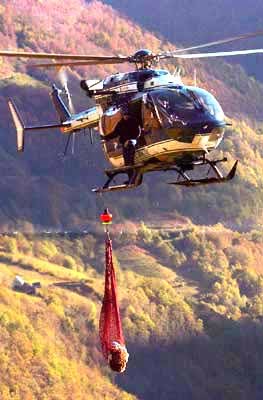
The Lifeless body of Canelle isTransported Away by Helicopter.

In November 2004 in the Aspe Valley, the last female brown bear in the Pyrenees of Pyrenean stock (as apposed to the female brown bears introduced from Slovenia), was shot and killed by a hunter while he was out hunting wild pigs.  René Marquèze said he acted in self defence. He later faced trial and had to pay 10 000 Euros in damages to several environmental organistions.

Cannelle (Cinnamon in English) was with her cub which was not physically hurt and escaped. The mothers body was frozen and stored at the National Veterinary School in Toulouse while the judicial enquiry into the cause of her death took place. This did not finish until 2009. Now, the director of the Natural History Museum, also in Toulouse, Francis Duranthon,  wants to defrost the body so that it can be mounted by a taxidermist and displayed to the public.

Wednesday, June 15, 2011

Bear End?

After 15 years of positively encouraging the survival of the brown bear in the Pyrenees, the French government appears to have taken a step backwards. In early June it announced that there would not be a new release in the Pyrénées-Atlantiques as planned. Pro bear campaigners felt that it was imperative that a female bear was reintroduced in Bearn in the Aspe or OssauIt valleys to replace Franska (herself a reintroduction from Slovenia) killed when she was hit by a car on a busy road in August 2007. Two male bears survive in the area but cannot breed. There are only about 20 brown bears left in the Pyrenees. They do not exist anywhere else in France.


Franska introduced to the Pyrenees from Slovenia (April 2006), killed in a road accident (Aug. 2007.)
Picture from http://www.buvettedesalpages.be/

In the past, Nathalie Kosciusko-Morizet, the state secretary for ecology in the Sarkozy government, has made clear her determination 'to restore the population of bears in the Pyrenees in accordance with France's international obligations for biodiversity.' However, earlier this month, she refused to authorise the release of new bear from Slovenia, citing the problems that mountain farmers were facing due to persistant dry weather. Nathalie Kosciusko-Morizet's  decision goes against that made by her predecessor in July 2010 and appears to be at odds with the Governmen'ts National Strategy For Biodiversity that she herself introduced in May 2011.

The French National Strategy for Biodiversity Logo (May 2011) includes Bear Prints
 

WWF France announced that the Governments decision was 'disgusting and would have huge consequences for biodiversity.' It added that perhaps with a strong hunting and farming lobby in France, President Sarkozy has one eye on the 2012 Presidential Election.

Mountain farmers were pleased with the decision. They argue that the reintroduction of Slovenian brown bears to boost the population in the Pyrenees and increase the long term viability of the animal, would add to the already considerable difficulties they face. Bears attack and kill their animals.

Cartoon from http://www.buvettedesalpages.be/


Sunday, April 24, 2011

The Bear Facts


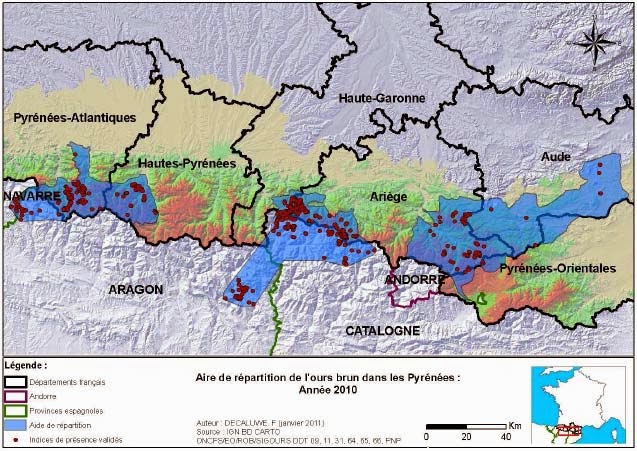
At the time of year that sees bears waking from the winter hibernation, the annual report by the Bear Team of the Hunting and Wildlife Commission has been published. The report published in early April, states that 19 bears were identified in the Pyrenees in 2010. 17 were to be found on the French side of the chain - the others in Spain. 4 of the 19 are bear cubs.The brown bear can only be found in France in the Pyrenees.

Where the Brown Bear Was Located in the Pyrenees in 2010


The authors of the report state that 19 is a minimum. There are at least 19 bears because other bears present may not have been detected. It is very difficult to accurately determine the number of bears. Actual sightings are rare. Other indications that bears are present are droppings, footprints, tree scratching, animal kills and damage to bee hives.
By 1995 the brown bear population was down to 5. Worried about the complete disappearance of the animal from France, bears were reintroduced from Slovenia in 1996 (2 females) and in 1997 (1 male). Melba, one of the reintroduced bears, was killed in 1997 and Cannelle, the last female brown bear of Pyrenean origin, killed in 2004, both shot by hunters. Despite this, by 2005 the brown bear population had grown to 15. Still not considered viable, numbers were again augmented in 2006 by animals from Slovenia.  4 new females (Palouma, Franska, Hvala and Sarousse) and a male (Balou) were released.  Two of the four introduced females have died. One fell from a cliff in a freak accident, the other (Franska) was killed by a car on a busy stretch of road (the autopsy revealing evidence that she had been shot at.) Other females have given birth to cubs.
The reintroduction of bears has led to a heated debate between the pro (e.g.Pays de l'Ours-Adet; Ferus) and anti bear factions
The pro bear groups are waiting impatiently for more reintroductions to replace the bears that have been killed since 2006.
Environment Minister Nathalie Kosciusko-Morizet.
In July 2010, the government gave the go ahead for the reintroduction of another female bear to help keep the bear population viable but the Environment Minister Nathalie Kosciusko-Morizet has yet to give any further details.
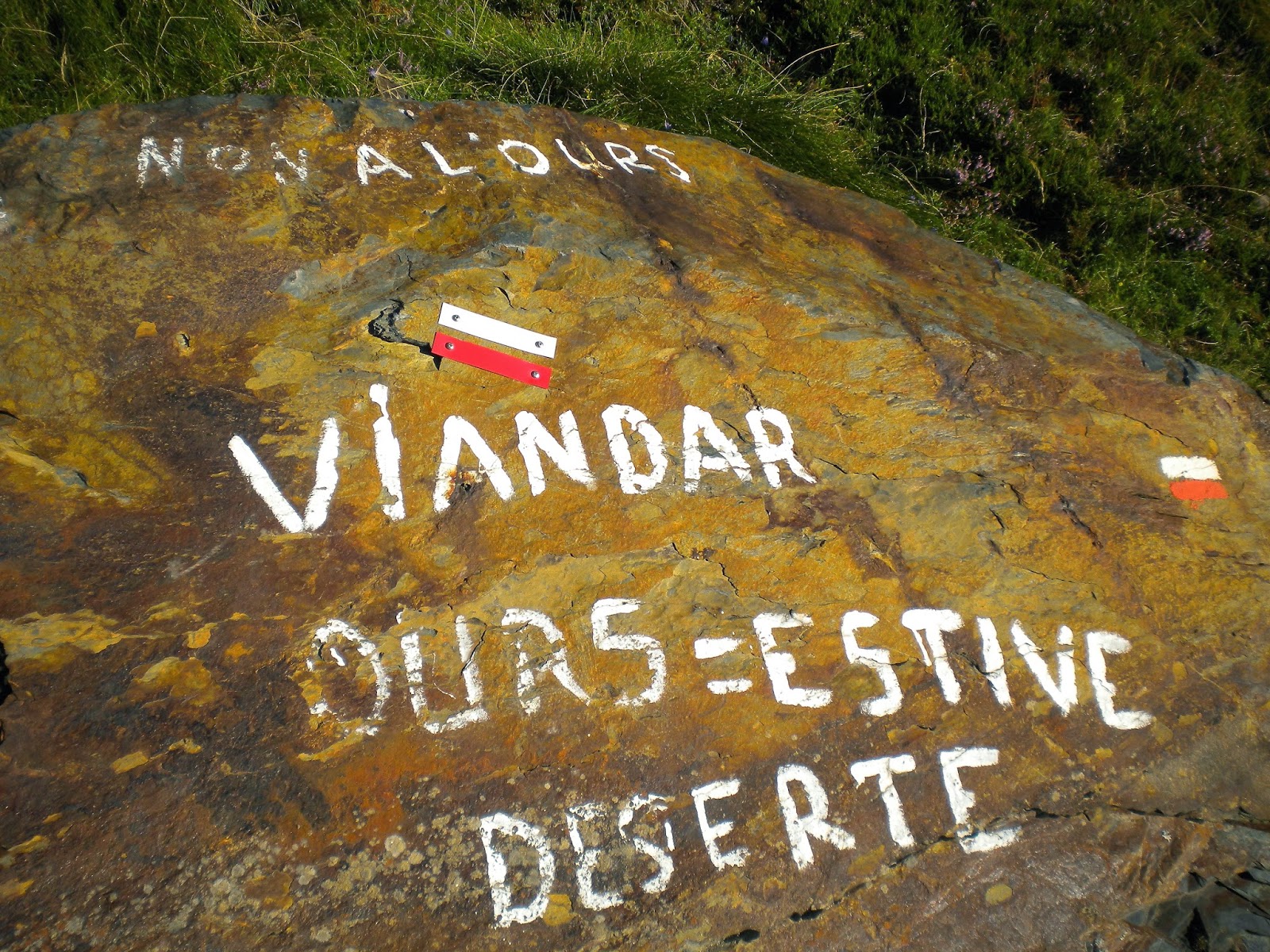
Anti Bear Graffito. If the bears come, the farmers will disapear.


The anti bear groups, made up mainly by shepherds, who fear damage to flocks from attacks by bears, do not want any more bears reintroduced. For them, the use of high mountain pastures during the summer months by their sheep, goats and cattle (transhumance) is incompatible with a growing bear population. According to them,  farming in the mountains is already unattractive financially. Increased loss of stock to bear attacks further reduces profitability and will lead to more farmers leaving the land.

200-300 sheep are killed by bears  each year. The pro bear lobby counters with the fact that wild dogs kill more animals. They also state that farmers are compensated by the government financially for every animal lost in a bear attack. There is also money to pay for farmers to have guard dogs - the formidable Patou mountain dog -  to help protect flocks and herds.