
Showing posts with label Books. Show all posts
Showing posts with label Books. Show all posts
Thursday, March 6, 2014

Sunday, February 10, 2013
On This Day 10th February 1939
The Spanish Civil War was fought from 17 July 1936 to 1 April 1939 between the Republicans, who were loyal to the established Spanish republic, and the Nationalists, a rebel group led by General Francisco Franco who had links with Nazi Germany and Fascist Italy.
By late 1938 the Nationalists had the upper hand and they launched an offensive against Republican controlled Catalonia and its capital Barcelona.
 |
| Nationalists Troops in Barcelona on 26 January 1939 |
The fall of Barcelona caused a massive exodus of people away from the encroaching Nationalist army of Franco towards the only safe haven available - France. They were ill prepared for the wintry conditions and progress was also made hazardous by attacks from Nationalist aircraft. This migration has become known as the Retirada (from the Spanish for 'retreat'.)
Initially the French border remained closed, the French authorities fearing an influx of revolutioary communists. Thousands gathered at border checkpoints - there were no open borders then but armed guards at border crossing points to check papers.
 |
| Refugees Waiting to Enter France at le Perhus |
The border was finally opened by the French on 28 January 1939, but only for civilian refugees. Soldiers who had fought with the Republican army had to wait until 5th February to be allowed to enter into France.
It is estimated that from 28th January to 9th February, as many as 500,000 men, woman and children crossed the Pyrenees, eventually passing into France.
Some through regular border crossings, like le Perthus, where their entry would have been regulated and recorded, others across high mountain passes where there was no official control of movement. 500,000 leaving behind their homes, the majority of their possessions and their work.
 |
| Freedom Trails |
Some through regular border crossings, like le Perthus, where their entry would have been regulated and recorded, others across high mountain passes where there was no official control of movement. 500,000 leaving behind their homes, the majority of their possessions and their work.
On February 10th, Franco had the border shut reducing the number of refugees fleeing although those determined enough could still pass over the Pyrenees on the harder mountain paths.
Once the refugees had made the difficult journey and crossed the border, things did not immediately improve for the majority. The cold, hunger, uncertainty, fear and death remained. The French government had envisaged an influx of refugees but nothing on such a huge scale and found themselves overwhelmed and unable to cope. The stop gap solution consisted of internment of refugees in 'concentration' camps hastily built on the beaches at places like Argelès and Rivesaltes. Initially mostly barbed-wire enclosures on the sand, without basic shelter, sanitary or cooking facilities. Refugees slept on the sand and had to build the barracks that offered protection from the elements themselves.
 |
| The Camp at Argeles sur Mer |
 |
| The Camp at Argeles sur Mer |
Conditions
were very harsh. Lack of shelter, food, sanitation and clean drinking
water led to many deaths. Some estimates put the number at 10,000.
 |
| Memorial to Those Refugees Who Died at Argeles sur Mer |
Despair and
frustration at the conditions and their treatment from the French authorities led some refugees to choose to return to Franco’s New Spain rather than stay in France. For those
who remained in exile – some 200,000 – there was the
Second World War to deal with. Some joined the French Resistance to fight the Nazi occupiers. They hoped to hasten the defeat of Nazi Germany so that the post WWII democracies would overthrow the Franco regime. The Nazis were defeated but Franco remained in power until 1975.
Many foreigners fought in the Spanish Civil War on both the 'left' and 'right'. Laurie Lee, the author ('Cider With Rosie') fought for the Republicans and wrote about his experience in the book 'A Moment of War' (1991). To get to Spain involved crossing the Pyrenees which Lee accomplished in December 1937 during a snowstorm! George Orwell also fought in the war as did Ernest Hemingway.
Laurie Lee 'A Moment of War' (1991)
George Orwell 'Homage to Catalonia'
Museu Memorial de l'Exili, La Junquera. A museum devoted entirely to the Retirada
Robert Capa photographs of the Argelès Internment Camp
Documentary (in French) Many good photographs and footage
Tuesday, January 22, 2013
Cruel Crossing
In November 2011 BBC Radio 4 broadcast a programme (in 2 parts) called The Freedom Trail. In it we follow Edward Stourton as he makes the crossing from France into Spain following the route of an old WW II escape route called Le Chemin de la Liberté or Freedom Trail.
Edward Stourton has now turned the radio programme into a book which will appear in April 2013. It is called Cruel Crossing: Escaping Hitler Across the Pyrenees.

The book is based on his own experiences of crossing the Pyrenees and first hand accounts from those who made the journey during WW II. As well as interviews with survivors from the time, Stourton also had access to diaries and journals. Relatives were also a precious source of information.
It is obvious from the book that tremendous courage and determination was shown by those attempting to escape and all those in the support network that helped so many to succeed. Exhaustion, malnutrition and sickness had to be contended with and there was the constant fear of capture, torture and death. Many of those in the Allied forces who successfully crossed into Spain, later
returned to fight or to gather intelligence and work with the French.
We also learn that it was not only forces personel who wanted to escape. A large number of Jews and communists made the crossing to escape persecution and the Death Camps. Young French also crossed to escape the STO (Service du travail obligatoire) or Compulsory Work Service/Forced Labour.
Saturday, May 5, 2012
Top 10 Pyrenees Guide Books
There are a range of Pyrenees guide books on offer that I have used, and continue to use, to put together interesting walks and treks for Pyrenees Mountain Adventure that show off the best the Pyrenees has to offer . Here are my Top 10.

Best For General Information: Rough Guide to the Pyrenees (6th Ed. 2007)

Best For General Information: Rough Guide to the Pyrenees (6th Ed. 2007)
Covering the whole chain in detail and packed full of information. I am still using my 1995 edition. Essential.
"These mountains challenge and invite rather than intimidate."

'Especially intended for the use of mountaineers.' The first guide to the Pyrenees in English. Still in print and still of use in terms of ideas about where to walk. Very interesting to read to see what has changed since 1862 and what has stayed the same. The wolf and ibex that Packe mentions are extinct now in the Pyrenees and the shelter on the summit of Pic Canigou has also gone but the Eyne Valley has not lost its world class reputation as a site for alpine flowers.
"Inferior, indeed, to the Alps in height and expanse of barren glacier, but far more picturesque in form as well as colour"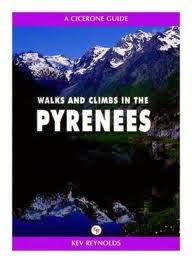
Covers the High Pyrenees from Pic D'Anie to Pic Carlit - ignoring the parts of the chain closest to the Atlantic and Mediterranean. Includes 170 routes which are mostly day walks but there are several 2 and 3 day treks. Also includes routes along a section of a section of the Haute Randonnée Pyrénéan (HRP) of 24 days broken down into 3 stages. There are no walking maps.
"For the walker and trekker, the range has just about everything."
Concise. Pocket sIzed. Cover photo is 2001 edition

Rosemary
Bailey takes a journey through the Pyrenees. In the process we learn
more about this beautiful region and the lives of some of the colourful
characters who explored and popularised the area in the nineteenth
century. Foremost among them is Count Henry Russel (a friend of Charles Packe) who had an
astonishing relationsip with the highest peak on the French side of the
chain – the Vignemale.
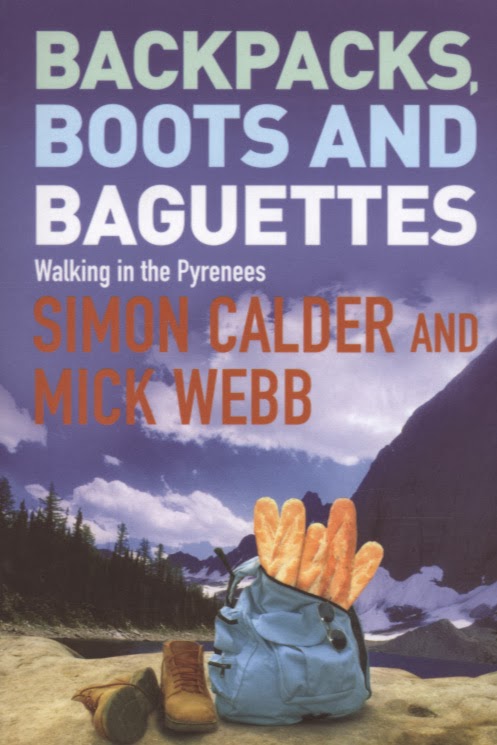
A humerous, informative account of completing the GR10 Traverse across the Pyrenees from Atalantic to Mediterranean. A good introduction to the Pyrenees.

A more user friendly version of Walks and Climbs with more information, better maps and more photos.
'A magical range of mountains'
'The finest trekking in all Europe is to be found in the Pyrenees'

A guide that covers the whole GR10 - one of several long distance paths that traverse the Pyrenean Chain. 80 detailed maps showing timings, accommodation and points of interest. Good language section and includes some historical and geographical background as well as information on flora and fauna.
'This is an area of awe-inspiring beauty'
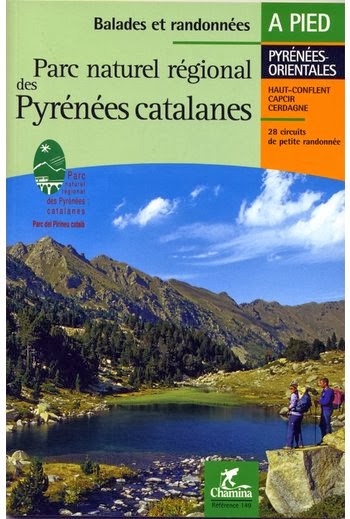
A guide book (in French) that concentrates just on the Catalan Pyrenees Regional Nature Park found in the Eastern Pyrenees closest to the Mediterranean - the sunniest part of the chain. 26 day walks and 2 weekend treks. Route description plus 1:25000 IGN map extract. Includes much useful general information on the geology, history, fauna and architecture of the area.
'A paradise for the walker.....there is something for all tastes and all levels'

The GR11 or 'La Senda' (The Track) is the Sapnish equivalent of the GR10 and this is the only English language guide to the route. A coast to coast traverse of the Pyrenees on the Spanish side of the chain.

Unlike the GR10 and GR11 the Haute Route crosses the French-Spanish
border many times, exploring both sides of the mountain range and
staying as close as possible to the main ridge of the Pyrenees.
The classic text is by George Veron (Pyrenees High Level Route 1991) the Frenchman who laid the foundations for the hardest of the coast to coast traverse routes but it is out of print.
Joosten's Cicerone guide is argueably as good. He walked every stage of the Haute Route more than once and all the
stages in the high mountains at least three times.
800km broken down into 42 stages including 500 GPS Waypoints to help with navigation..
Want help planning your perfect Pyrenees mountain adventure? Have a look at the Pyrenees Mountain Adventure website: www.pyreneesmountainadventure.com
The Pyrenees Mountain Adventure team look forward to hearing from you soon.
Wednesday, July 27, 2011
Business As Unusual
|2 Oct 2009. Patagonia asks the experts: What are the greatest threats now facing the environment? Is sustainability a real and achievable goal? Can business ever move beyond sustainability - leaving the planet better than we found it? How do we need to change business - and our behavior - to start to substantially lighten our footprint? We get some surprising and contradictory answers.
Sunday, June 19, 2011
Book Release
A book of my photos, taken while walking and snowshoeing in the Eastern Pyrenees, is now available to buy. The book is called Summer and Winter in the Eastern Pyrenees.


Subscribe to:
Comments (Atom)